
Quick Summary: Most Australian landlords underestimate the total costs of self-management, which include time, legal risks, and vacancy losses. Property management fees can be justified by reducing errors, legal issues, and vacancy impacts, especially for larger or distant portfolios. Self-management works best for nearby, small, and stable properties with owners who can handle legal and administrative tasks. Ultimately, choosing between self-management and landlord services depends on your property size, location, and willingness to manage risks and time.
Most Australian landlords save less than they expect by going solo. Once you add vacancy risk, legal slip-ups, and your time, Property Management Fees often stack up well in a Landlord Cost Analysis. This Landlord Cost Analysis compares Self-Management Costs with agent fees in real Australian dollars. Built for first-time investors and existing owners, this Landlord Cost Analysis shows the break-even point by property type, distance, and hassle tolerance.
Landlord Services vs Self-Management: Cost Snapshot
| Landlord services | Self-management | |
|---|---|---|
| Annual cash cost | Higher upfront; includes management fee, leasing fee, and possible add-ons | Lower cash outlay, but time and error costs can be significant |
| Time commitment | Low; owner is mostly hands-off | High; calls, inspections, repairs, and admin fall on the owner |
| Legal and compliance risk | Lower; managed by tenancy professionals | Higher; owner must stay current with tenancy rules |
| Best for | Busy landlords, interstate owners, larger portfolios | Nearby properties, small portfolios, hands-on owners |
| Scalability | Strong; easier as door count rises | Weak at scale; workload rises quickly |
| Stress level | Low to moderate | Moderate to high |
How Landlord services and Self-management Compare
Landlord services
Landlord services use a licensed manager to run leasing, rent, repairs, inspections, and compliance. They suit busy owners, interstate investors, and landlords who want less day-to-day work. In WA, property managers help owners avoid the daily load and work under agency rules set out by Consumer Protection WA.

Self-management
Self-management means you run the tenancy yourself, from tenant contact to repairs and records. It fits hands-on owners with nearby properties and smaller portfolios. NSW says landlords can self-manage and save agent fees, but they still must follow tenancy law under NSW Government guidance.
What You Actually Pay For
The real cost is rarely the headline fee. Most landlords pay for admin, leasing, inspections, and risk control, not just rent collection.
- The fee line most investors miss
A low management rate can still cost more once you add letting, lease renewal, inspection, admin, and tribunal charges. In Australia, the ATO lists property agent fees and commissions as rental expenses, but that does not make every extra fee good value according to the ATO. - Why self-management is never truly free
You save the manager’s invoice, but you still pay in time, tenant screening, repair call handling, record keeping, and legal risk. The ATO says some travel to inspect or collect rent for residential rentals is not deductible unless limited exceptions apply under current ATO rules.
Also Read: https://smartrealty.com.au/property-management-company
Risk, Compliance, and Vacancy: The Hidden Swing Factors
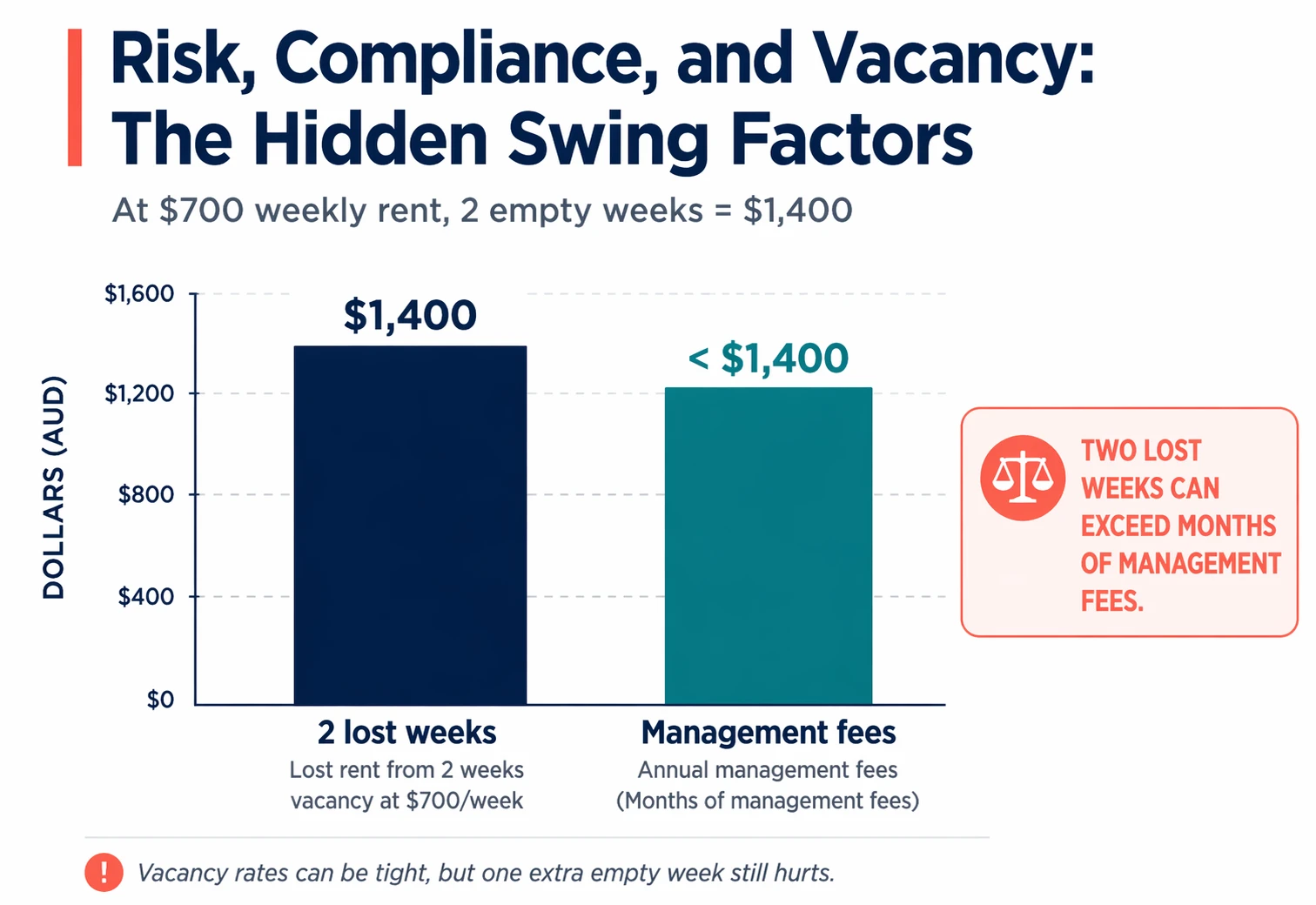
A short vacancy can wipe out the savings from self-managing. In May 2026, Australia’s national vacancy rate was just 1.2%, with Perth at 0.7%, according to SQM Research. That sounds tight, but one extra empty week still hurts. On a $700 weekly rent, two lost weeks costs $1,400. That can exceed months of management fees.
If your ad, inspections, screening, or follow-up are slow, the real cost is lost rent, not the fee you avoided.
Legal mistakes are not minor admin errors. NSW Fair Trading says re-letting breaches have already led to fines, with 12 fines totalling $50,050 and one agency fined $35,750 for re-letting during an exclusion period, as reported by NSW Government. Good managers help reduce that risk.
Also Read: https://smartrealty.com.au/rental-property-management
Which Option Fits Your Portfolio and Lifestyle?
When self-management makes sense
Self-management suits landlords with one nearby property, flexible time, and solid admin habits. You save fees, but you still carry the legal load. In WA, landlords must lodge bonds within 14 days under Consumer Protection WA.

When landlord services make more sense
Landlord services fit busy owners, interstate investors, and anyone scaling past one or two rentals. NSW Government notes agents can handle rent, repairs, inspections, and disputes, though landlords still remain legally responsible.
Also Read: 7 Landlord Services That Save Time for Busy Investors
Which Should You Choose?
Choose self-management if your property is close, your tenant is stable, and you know the rules. Choose a property manager if you value time, distance, and lower risk. Landlords stay legally responsible either way, per NSW Government guidance. If one mistake, vacancy, or tribunal issue costs more than annual fees, management usually wins.

Want fewer surprises and better returns? Talk to Smart Realty for clear fees, local support, and simpler landlord decisions.
Frequently Asked Questions
Q1: What are the true costs and time commitments of self-managing rental properties in Australia?
Self-management saves visible fees, but you still pay in time, leasing costs, admin, tribunal prep, and mistakes. Many landlords spend several hours each month, plus extra time during vacancies, arrears, repairs, and compliance checks.
Q2: How do property management fees and legal risks compare to self-management costs for Australian landlords?
Management fees look higher upfront, but they can cut costly errors with bonds, notices, rent reviews, and inspections. Self-managing can work, yet one compliance mistake or long vacancy may wipe out the fee savings fast.
Q3: What factors make self-management feasible for small Australian property portfolios?
It works best when you live close, know state rules, have reliable trades, and can answer tenants fast. A simple portfolio, stable tenants, and strong admin habits make self-management more realistic and lower risk.
Conclusion
Self-management saves fees, but not time or risk. NSW Government says landlords still carry legal responsibility, while Consumer Affairs Victoria notes fees are negotiable. Pick the option with the lower all-in cost for your situation.